
Garden office insurance UK: do you need cover?
Yes, most likely, and you probably need more than your standard home policy gives you. Standard buildings and contents insurance often extends some cover to a garden office, but the limits are usually too low for a proper workspace, and using the space for business can void a claim entirely if you haven’t told your insurer.
Statistic callout: Which?'s research found that 91% of the 75 policies it checked cover theft and damage to outbuildings, but the payout limits vary hugely from one insurer to the next.
Do this today:
- Pull out your policy schedule and search for “outbuildings” and “contents in the open.”
- Check the single item limit against what’s actually sitting in your garden office.
- Call your insurer or a broker if you use the space for work, or if it holds anything expensive.
Key Takeaways
Adequate garden office cover depends on declaring business use honestly, matching contents value to your policy’s outbuilding limits, and keeping build specifications ready for insurers.
| Point | Details |
|---|---|
| Check your policy schedule | Search for “outbuildings” and “contents in the open” limits before assuming you’re covered. |
| Declare business use | Regular client visits, stock, or paid services usually need specialist or business cover. |
| Watch single item limits | Individual high-value items may need listing separately to avoid a capped payout. |
| Improve security | Multi-point locks, alarms, and CCTV can support a claim and may reduce premiums. |
| Use build specifications | Logcabinkits’ specification packs help insurers assess rebuild value accurately from the start. |
Table of Contents
- How standard home insurance usually treats garden rooms and outbuildings
- When you need specialist or business cover for a garden office
- What garden office insurance commonly covers, and where it stops
- How insurers assess risk and what you must declare
- Security steps that reduce risk and may lower premiums
- How much garden office insurance costs, and what shapes the price
- How to choose the right cover and what to tell your insurer
- How Log Cabin Kits’ product specs affect insurance conversations
- Claims process for garden office insurance in the UK
- Impact of planning permissions and building regulations on insurance eligibility
- Get insurance-ready specifications from Logcabinkits
- Sources
How standard home insurance usually treats garden rooms and outbuildings
Home insurance splits into two parts: buildings cover and contents cover. Buildings cover protects the structure itself, so a garden office normally falls under this if it’s a permanent build. Contents cover protects what’s inside, but this is where things get tight.
Here’s what tends to catch people out:
- Outbuilding limits are often capped separately from your main contents sum, sometimes at a fraction of what’s inside a well equipped office.
- Unspecified item limits mean a single laptop or camera over a certain value might not be covered unless you list it by name.
- Theft claims from outbuildings usually need proof of forced entry, so a locked door with no broken lock or window can mean a declined claim.
Which?'s analysis of garden insurance cover makes clear that this variation between policies is significant, not a minor footnote. Reading your schedule properly, rather than assuming you’re covered because you have “buildings insurance,” is the single biggest step you can take before anything goes wrong.
When you need specialist or business cover for a garden office
If you work from your garden office regularly, home insurance on its own usually isn’t enough. Insurers draw a clear line between someone who occasionally checks emails in a garden room and someone running a business from it.
You’ll likely need extra cover if:
- Clients or customers visit your garden office in person.
- You store stock, equipment, or tools connected to a trade.
- You sell services or products from the space, even part time.
- You employ anyone who works from that building.
Anthony Jones’s guidance on garden rooms and home insurance points out that cover depends heavily on how the room is actually used, not just what it’s called on paper. A quiet freelance desk is treated very differently to a therapy room with regular footfall.
This is exactly where a broker earns their fee. Garden Office Guide’s advice on insuring a garden office notes that brokers regularly source specialist policies when standard insurers won’t budge, particularly for bespoke builds or higher value setups.
What garden office insurance commonly covers, and where it stops
Most policies covering garden buildings handle the big, obvious risks well: storm damage, fire, and theft following forced entry. Where people get caught out is in the smaller print around what’s excluded.
Common gaps to watch for:
- Items left outside the building, even briefly, are usually not covered at all.
- Flat roof exclusions appear on some policies, so check this if your garden office has a flat or low pitched roof.
- Proximity to large trees can affect cover if a claim involves falling branches or subsidence.
- Plants and garden features are often excluded or capped at very small amounts, according to Confused.
Statistic callout: Because outbuilding limits vary so widely between insurers, a monitor, camera, or specialist chair worth a few hundred pounds can easily exceed a single item cap without you realising. Listing high-value items separately on your policy closes that gap.
How insurers assess risk and what you must declare
Insurers care a great deal about permanence. A garden office on solid foundations, with fixed wiring, is treated differently to a lightweight structure that could be moved.
What tends to raise scrutiny, and rebuild value:
- Fixed foundations, rather than paving slabs or timber runners.
- Mains electricity wired into the building, rather than an extension lead.
- Heating systems, insulation, and any plumbing.
- Overhanging trees or a location prone to flooding nearby.
Grove & Dean’s guide to garden upgrades and home insurance explains that fixed utilities push insurers to reassess rebuild costs properly, rather than lumping the building in with garden sheds.
Pro Tip: Keep your original build invoice and specification sheet somewhere safe. If you ever need to prove rebuild value quickly, that document does the job in minutes rather than weeks.

Security steps that reduce risk and may lower premiums
Insurers like to see effort. A locked door helps, but a few extra steps can make the difference between a smooth claim and a rejected one.
Worth putting in place:
- Multi-point locking systems on doors, not just a single latch.
- An approved alarm system, particularly if the office holds business equipment.
- Exterior lighting and CCTV covering the entrance.
- Photographs, receipts, and serial numbers for anything valuable, stored somewhere other than the building itself.
Practical advice on securing outbuildings shows how straightforward some of these upgrades are, and insurers often reward them with better acceptance terms, sometimes with a lower premium too.
How much garden office insurance costs, and what shapes the price
There’s no single answer here, because the price depends on several moving parts rather than one figure.
What usually drives the quote up or down:
- The rebuild value of the structure itself.
- The total value of contents, especially electronics and furniture.
- Whether you’ve declared business use.
- Security measures in place.
- Your postcode, and local crime or flood risk.
Statistic callout: Given that outbuilding limits already vary across the policies Which? reviewed, it’s no surprise premiums vary just as much. Two homeowners with identical garden offices can get very different quotes simply because one declared business use and the other didn’t.
Brokers often find different prices for the same risk because they’re checking against a wider panel of insurers than you’d reach alone.
How to choose the right cover and what to tell your insurer
Getting this right doesn’t need to be complicated. Follow these steps in order and you’ll walk into any conversation with an insurer fully prepared.
- Find your policy schedule and search for “outbuildings” and “contents in the open.” Note the limits next to each.
- Total up your rebuild and contents value, then list anything high value separately, along with any planned business use.
- Ask direct questions: what’s the single item limit, is there a flat roof exclusion, and what security conditions apply? If the answers don’t fit your situation, a specialist broker can usually find a better match.
| Question to ask | Why it matters |
|---|---|
| What’s the outbuilding limit? | Confirms whether your contents value fits within the cap. |
| Is business use declared? | Casual use and declared business use are treated very differently. |
| Are there security conditions? | Missing a required lock or alarm can void a claim. |
How Log Cabin Kits’ product specs affect insurance conversations
Build specification changes the conversation with your insurer more than most homeowners expect. Wall thickness, double glazing, fixed wiring, and insulation all push up rebuild value, and insurers usually want to see them written down rather than guessed at.
- Thicker wall logs and insulation raise the rebuild figure insurers use.
- Double glazing and fixed wiring both count as permanent fittings, not optional extras.
- A clear specification pack saves time when a broker asks for evidence.
A garden office built to a proper specification, with the wiring, glazing, and insulation documented from day one, gives you a much easier conversation with an insurer than a structure nobody can describe in detail.
Logcabinkits can provide specification packs and rebuild-cost guidance alongside our garden log cabins and bespoke cabin design service, so you’re not starting from scratch when it’s time to get a quote.
Claims process for garden office insurance in the UK
Making a claim on a garden office follows the same broad pattern as any home insurance claim, but the paperwork tends to matter more because outbuildings attract extra scrutiny.
Start by contacting your insurer as soon as possible after damage or theft. Most insurers expect notification within a set number of days, so don’t wait until you’ve tidied up or replaced anything. Photograph the damage before you touch it, from several angles, and keep the area as close to the original state as you reasonably can.
You’ll typically need to provide:
- Photographs of the damage or the point of entry, if theft is involved.
- Receipts or proof of purchase for damaged or stolen items.
- Serial numbers, where applicable, particularly for electronics.
- A police reference number if theft or vandalism occurred, since insurers usually ask for this before processing a theft claim.
- Your original build specification or invoice, useful for proving rebuild value on the structure itself.
Insurers will often send an assessor for larger claims, particularly where the structure itself is damaged rather than just the contents. Being able to hand over a specification pack at this point speeds things up considerably, because the assessor isn’t left guessing at wall thickness or wiring standards.
Keep a written record of every phone call and email during the process. Claims can stall when documentation goes missing between departments, and having your own paper trail protects you if that happens.
Impact of planning permissions and building regulations on insurance eligibility
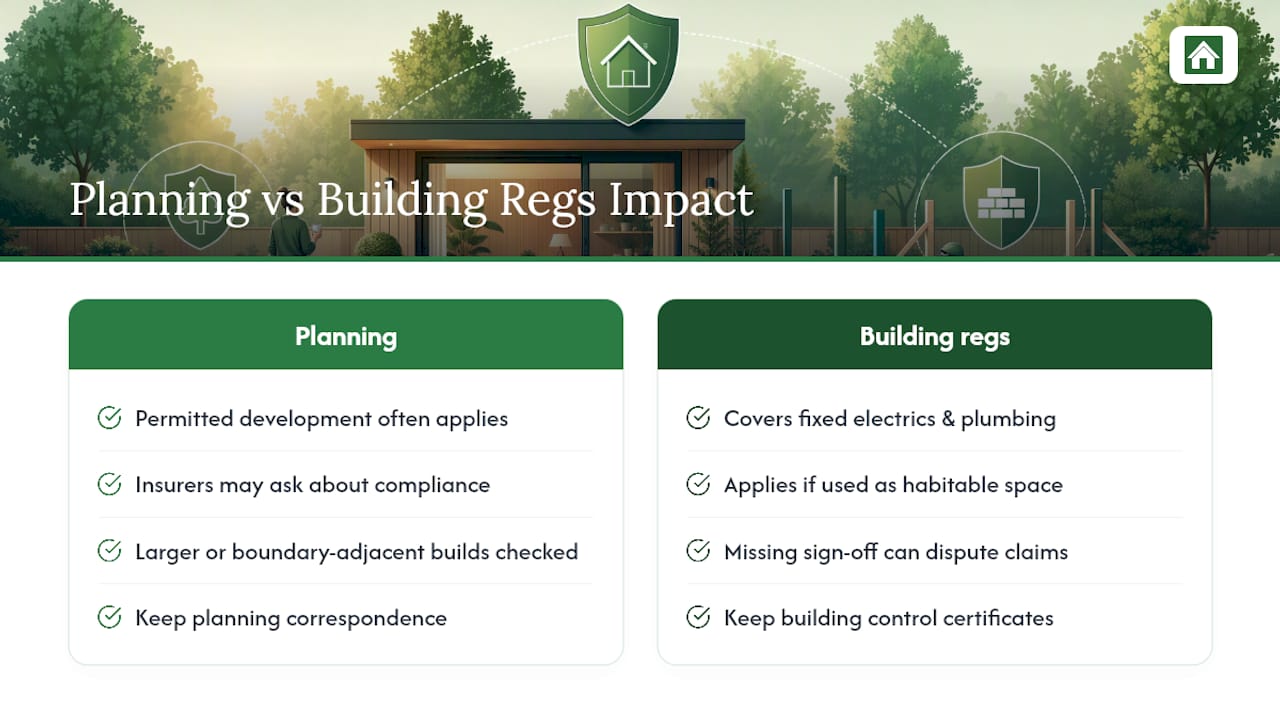
Planning permission and building regulations don’t always determine whether you’re insured, but ignoring them can cause real problems at claim time.
Most garden offices fall under permitted development rights, meaning formal planning permission usually isn’t required if the building meets certain size and height limits. However, insurers sometimes ask directly whether the structure complies with local planning rules, particularly for larger builds or those close to a boundary.
Building regulations are a separate matter, and this is where things get more serious for insurance purposes. If your garden office has fixed electrics, plumbing, or is used as habitable space, building regulations may apply regardless of planning permission status. An insurer discovering that required building regulations sign off was never obtained can, in some cases, use this to dispute a claim, particularly if the issue relates directly to the damage.
The safest approach is straightforward: check with your local council before building, keep any planning correspondence or building control certificates, and mention these documents when you apply for insurance. It costs nothing to have them ready, and it removes one more reason for an insurer to query a claim later.
A short note on sensible insurance choices
Getting this right isn’t about ticking boxes to satisfy an insurer. It’s about not being caught out when something goes wrong. Declare your business use honestly, fit a decent lock, and keep your build specification somewhere safe. If you’re buying a bespoke cabin, ask for the build documents from day one, it saves a headache later.
— Martin
Get insurance-ready specifications from Logcabinkits
Logcabinkits gives you something most garden building suppliers don’t: a proper specification pack and rebuild-cost guidance you can hand straight to your insurer or broker. Instead of guessing at wall thickness or wiring standards after the fact, you get the paperwork sorted before you’ve even finished building.
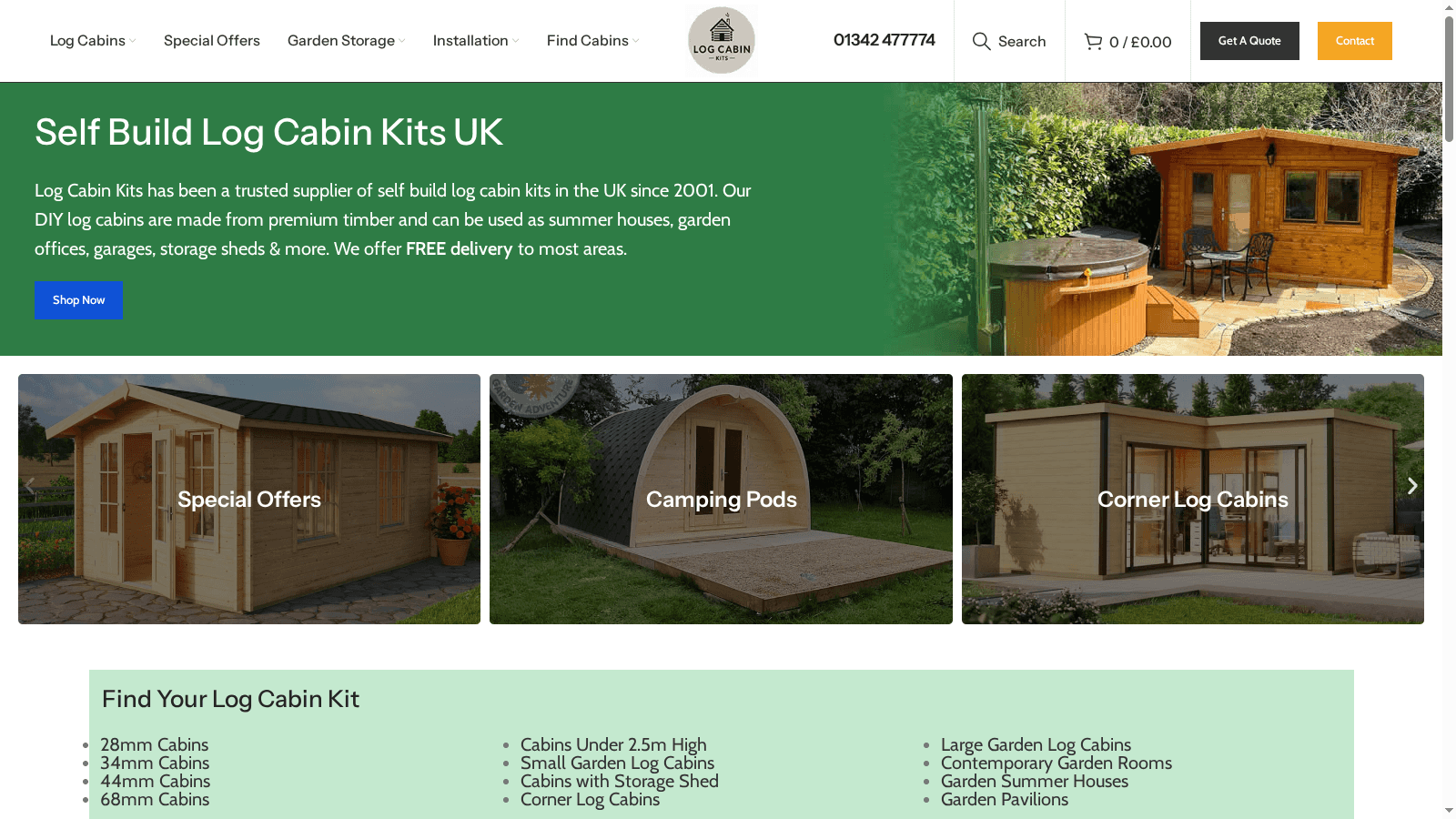
Our range of garden offices comes fully insulated and wired as standard, built to specifications that insurers recognise straight away. If your needs are more particular, whether that’s a bigger footprint, extra glazing, or a specific wall thickness, our bespoke cabin design service builds it around you rather than the other way round. Not sure which size or style fits your garden and your budget? Try our cabin selection wizard to narrow things down in a few minutes, or get in touch directly to request a bespoke specification pack ready for your next insurance quote.
Sources
- Does your home insurance cover your garden? - Which?
- How do garden rooms & offices affect home insurance? – Anthony Jones
- Insuring a garden office - Garden Office Guide
- Spring garden upgrades & home insurance guide | Grove & Dean